Punjab School Monitoring Initiative 2026
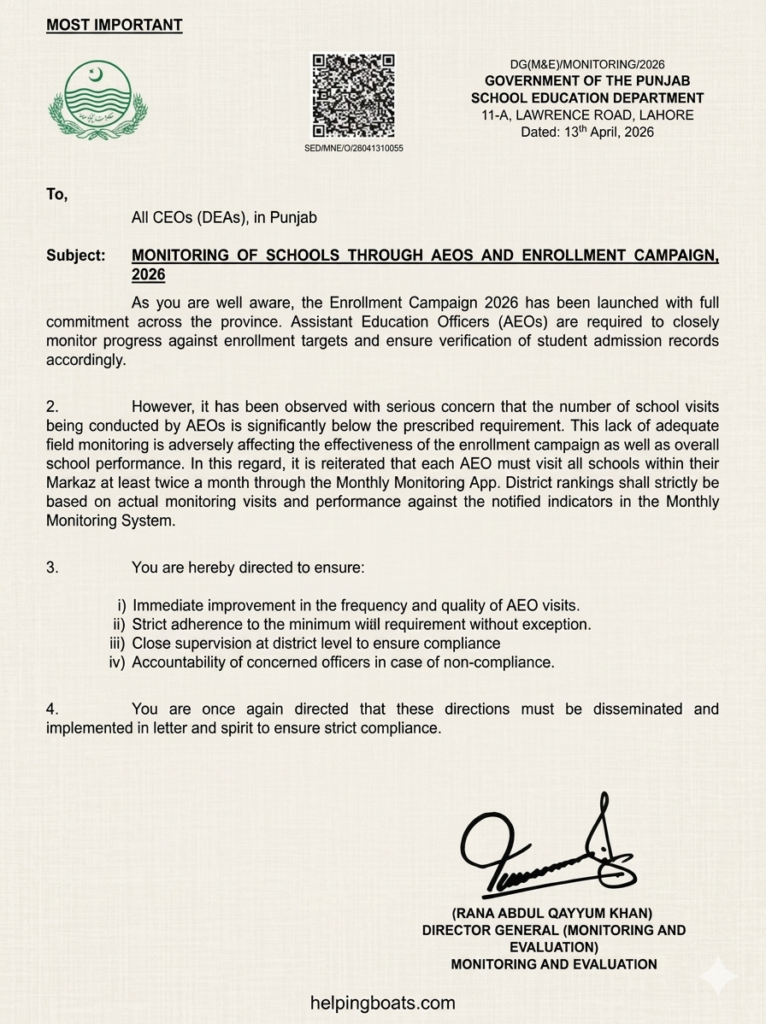
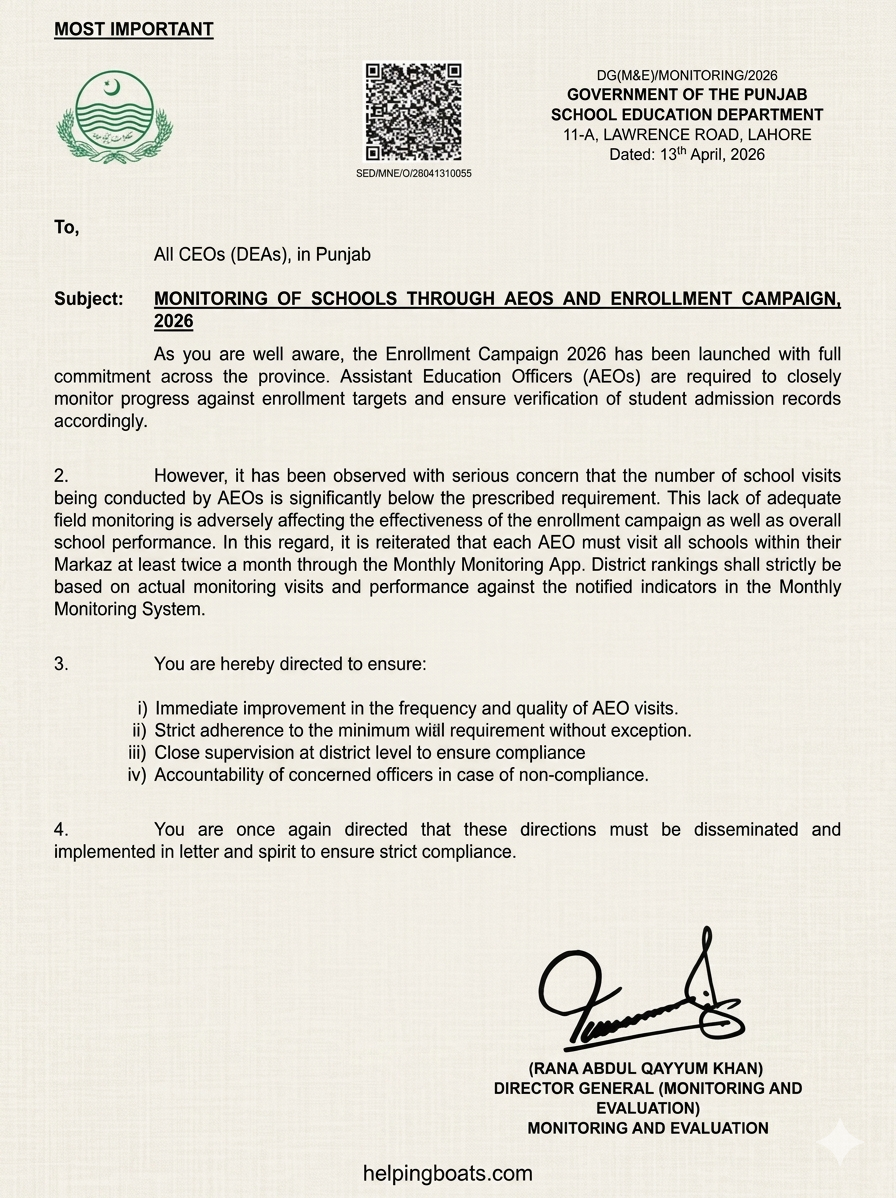
The School Education Department (SED) of Punjab has issued a high-priority directive to strengthen the effectiveness of its Enrollment Campaign 2026, signaling a renewed commitment to improving educational access and accountability across the province. This directive, formally released by the Monitoring and Evaluation (M&E) Cell, underscores the urgent need for enhanced field monitoring and stricter compliance mechanisms to ensure that enrollment targets are not only met but also verified through reliable, on-ground evidence.
At the heart of this initiative lies a growing concern within the department regarding the declining frequency and quality of school visits conducted by Assistant Education Officers (AEOs). Recognizing the critical role these officers play in validating enrollment data and maintaining educational standards, the government has moved decisively to enforce a more structured, data-driven monitoring framework.
Background and Rationale
Over recent years, Punjab has made significant strides in increasing school enrollment rates. However, sustaining and validating these gains has proven challenging due to gaps in field monitoring. Reports indicated that many schools were not being visited regularly, raising questions about the authenticity of reported enrollment figures and the actual presence of students in classrooms.
This gap between reported data and ground realities prompted the government to intervene. The Enrollment Campaign 2026 is not merely a drive to increase numbers—it is a comprehensive effort to ensure that every enrolled student is physically present, actively participating, and properly documented.
The directive reflects a shift from quantity-focused targets to quality-driven verification, where accountability and transparency are central pillars.
Core Objectives of the Directive
The directive introduces a clear and structured monitoring system designed to address inefficiencies and reinforce accountability among field officers. The primary objectives are outlined below:
- To ensure consistent and frequent school visits by AEOs
- To verify student enrollment through physical inspection
- To improve the quality of monitoring practices
- To establish a transparent ranking system for districts
- To enforce accountability through measurable performance indicators
Monitoring Framework Overview
| Feature | Requirement / Detail |
|---|---|
| Target Authority | Assistant Education Officers (AEOs) |
| Visit Frequency | Minimum of two visits per month per school |
| Monitoring Tool | Digital Monthly Monitoring App |
| Performance Metric | District rankings based on verified visit data |
| Primary Objective | Authentication of student admission and attendance |
This framework introduces a standardized approach, ensuring uniformity across districts and eliminating ambiguity in expectations.
Strengthening the Role of Assistant Education Officers (AEOs)
Assistant Education Officers are the backbone of the field monitoring system. Their responsibilities extend beyond routine inspections to include:
- Verification of newly enrolled students
- Assessment of classroom attendance
- Evaluation of school facilities and teaching standards
- Reporting discrepancies in enrollment data
The directive emphasizes that AEOs must transition from a passive reporting role to an active verification role, where their observations directly influence policy decisions and district rankings.
Enhanced Monitoring Through Digital Integration
A key feature of the 2026 initiative is the integration of technology through the Monthly Monitoring App. This digital platform serves multiple purposes:
- Real-Time Data Entry: AEOs are required to upload visit details immediately after each school visit.
- Geo-Tagging: Ensures that visits are physically conducted and not falsely reported.
- Data Transparency: Enables higher authorities to track performance instantly.
- Performance Analytics: Facilitates the generation of district-wise rankings based on actual data.
This shift toward digital monitoring minimizes human error, reduces manipulation, and enhances the credibility of reported figures.
Strict Compliance Measures
To ensure the success of the Enrollment Campaign 2026, the directive outlines a series of strict compliance measures. These are designed to enforce discipline, improve performance, and establish accountability at all levels.
Key Enforcement Pillars
- Immediate Quality Improvement
AEOs are required not only to increase the frequency of their visits but also to enhance the depth and quality of their inspections. Superficial visits will no longer be acceptable; officers must conduct thorough evaluations and provide detailed reports. - No Exceptions Policy
The requirement of conducting at least two visits per month per school is mandatory. No exemptions will be granted, regardless of circumstances. This policy ensures uniform compliance across all districts. - District-Level Supervision
Chief Executive Officers (CEOs) of District Education Authorities (DEAs) are tasked with directly supervising AEOs. Their responsibilities include:- Monitoring visit compliance
- Reviewing submitted reports
- Taking corrective actions where necessary
- Strict Accountability Measures
Non-compliance will result in disciplinary actions. These may include:- Formal warnings
- Performance penalties
- Administrative action under relevant service rules
District Rankings and Competitive Performance
One of the most impactful aspects of this directive is the introduction of a district ranking system based on monitoring performance and enrollment verification.
How Rankings Will Be Determined
| Criteria | Description |
|---|---|
| Visit Compliance Rate | Percentage of required visits completed |
| Data Accuracy | Consistency between reported and verified data |
| Enrollment Verification | Confirmation of actual student presence |
| Timely Reporting | Submission of reports within deadlines |
This ranking system introduces a competitive dynamic among districts, encouraging them to improve performance and maintain high standards.
Benefits of the Ranking System
- Promotes healthy competition
- Encourages accountability at district level
- Highlights high-performing districts as models
- Identifies underperforming areas for intervention
Emphasis on “Letter and Spirit” Implementation
The directive explicitly states that all instructions must be implemented in “letter and spirit.” This phrase carries significant administrative weight, indicating that compliance is expected not only in form but also in intent.
In practical terms, this means:
- Accurate and honest reporting
- Genuine field visits rather than symbolic compliance
- Commitment to improving educational outcomes
The department has also indicated that independent audits may be conducted to verify the authenticity of data entered into the monitoring system.
Role of District Education Authorities (DEAs)
District Education Authorities play a pivotal role in the successful implementation of this initiative. Their responsibilities include:
- Supervising AEO performance
- Ensuring adherence to visit schedules
- Reviewing monitoring data
- Addressing discrepancies promptly
DEA Responsibilities Overview
| Responsibility | Description |
|---|---|
| Oversight | Direct supervision of AEO activities |
| Verification | Cross-checking monitoring reports |
| Coordination | Ensuring alignment with provincial directives |
| Accountability Enforcement | Taking action against non-compliance |
Their leadership is critical in translating provincial policies into effective district-level execution.
Expected Impact on the Education System
The Punjab School Monitoring Initiative 2026 is expected to bring about several positive changes in the education system:
1. Improved Enrollment Accuracy
By verifying student admissions through physical visits, the initiative ensures that enrollment data reflects actual attendance.
2. Enhanced Accountability
Clear performance metrics and strict enforcement measures create a culture of responsibility among education officers.
3. Better Resource Allocation
Accurate data allows the government to allocate resources more effectively, targeting areas that need the most support.
4. Strengthened Public Trust
Transparent monitoring and reporting mechanisms increase confidence in the public education system.
Challenges and Considerations
While the directive is comprehensive, its success depends on effective implementation. Potential challenges include:
- Resistance to increased workload among AEOs
- Technical issues with the monitoring app
- Logistical constraints in remote areas
- Need for continuous training and capacity building
Addressing these challenges proactively will be essential for achieving the desired outcomes.
Summary of Key Information
| Entity | Details |
|---|---|
| Issuing Department | Monitoring & Evaluation (M&E) Cell, School Education Department Punjab |
| Directive Focus | Enrollment Campaign 2026 |
| Date of Issuance | 13 April 2026 |
| Primary Authority | Director General (M&E) |
| Target Officers | Assistant Education Officers (AEOs) |
| Monitoring Tool | Monthly Monitoring App |
| Location | 11-A, Lawrence Road, Lahore |
Conclusion
The Punjab School Monitoring Initiative 2026 represents a significant step toward strengthening the province’s education system through accountability, transparency, and data-driven decision-making. By enforcing regular school visits, leveraging digital tools, and introducing a competitive district ranking system, the government aims to ensure that enrollment figures are not only achieved but also genuinely reflect student participation.
This directive sends a clear message: educational progress is not just about numbers—it is about verified impact on the ground. With strict compliance measures and a strong emphasis on field verification, the initiative has the potential to transform how educational performance is monitored and improved across Punjab.
If implemented effectively, it could serve as a model for other regions seeking to balance ambitious enrollment targets with credible, evidence-based monitoring systems.